
AstraZeneca’s liquidity forecasting transformation
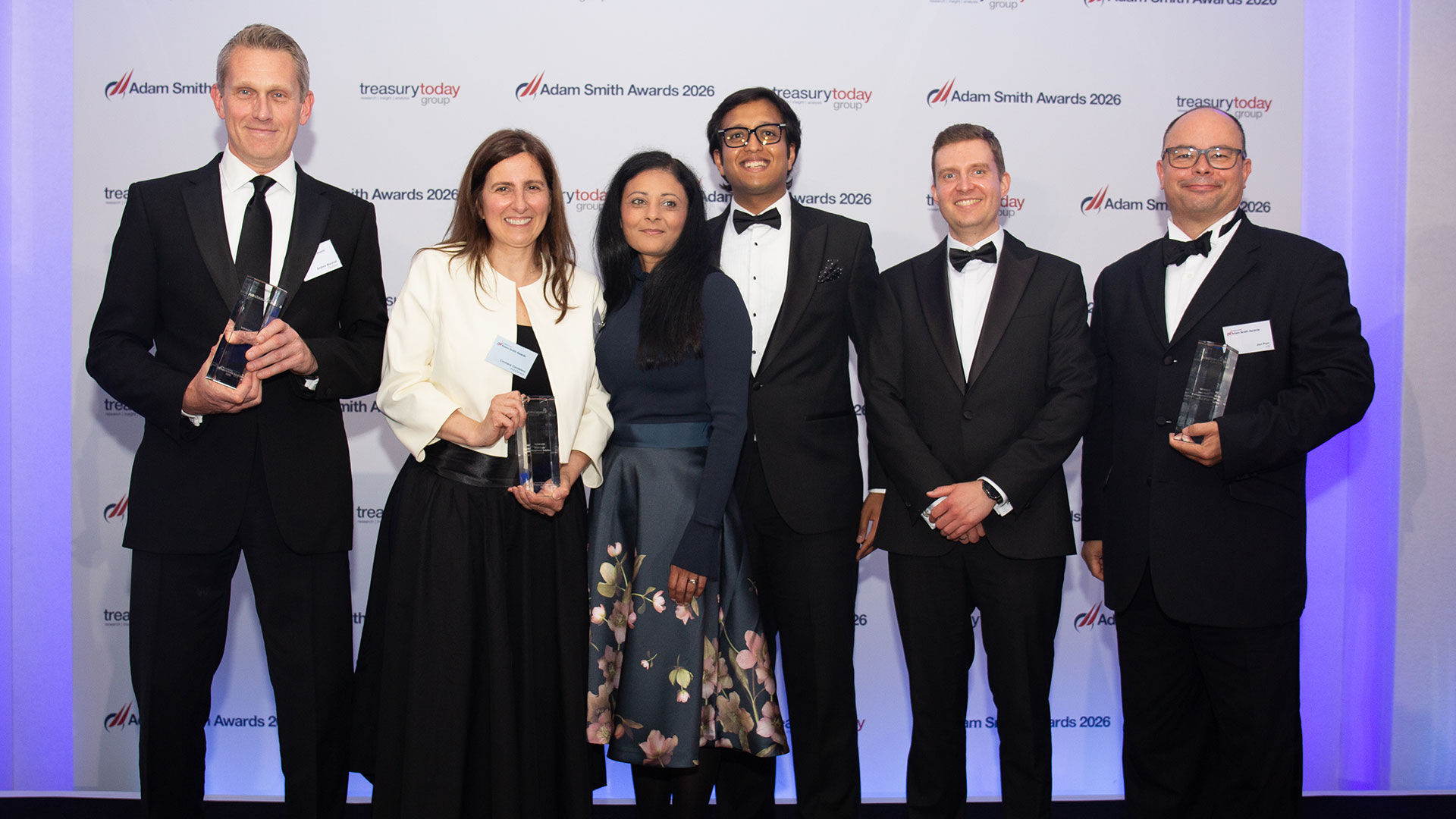
Best Cash Management Solution, Overall Winner at the Adam Smith Awards 2026
Global biopharmaceutical company formed in 1999 through the merger of Astra AB and Zeneca Group PLC, focused on oncology, biopharmaceuticals and rare diseases.
From one week of liquidity visibility to five
Liquidity visibility horizon, up from approximately one week
Entity coverage, up from three entities
Improvement in receipt prediction accuracy
The challenge
Originally published by Treasury Today, September 2026
AstraZeneca’s treasury organisation needed a more reliable global view of short-term liquidity across a complex multi-ERP environment. At that time, cash management decisions were supported by a combination of manually aggregating multiple SAP payment run data together with manual overlays, which limited consistency and transparency.
Customer receipts were particularly difficult to reflect accurately in short-term liquidity planning. Differences between expected SAP settlement dates and actual receipt patterns meant the treasury team could not include all receivables in funding decisions with sufficient confidence. As a result, some customer inflows were not consistently reflected in daily liquidity forecasts.
At the same time, AstraZeneca was progressing a longer‑term transformation to consolidate multiple ERP systems into a single SAP S/4HANA environment. This increased the importance of developing a scalable and more automated approach to liquidity forecasting.
The solution
AstraZeneca implemented a technology-enabled forecasting approach, designed to increase automation, improve visibility and support more informed funding decisions.
The solution included receipts forecasting technology and ERP connectivity tools that enabled payment and receivables data to be automatically extracted directly from multiple SAP ECC production systems and fed into the treasury systems. This eliminated the bulk of manual data collection and gave treasury access to more timely operational cash information.
AstraZeneca adopted enhanced forecasting techniques to better estimate when customer receipts were likely to be received. The forecasting framework combined established statistical approaches with predictive modelling techniques, using historical settlement behaviour to improve receipt timing estimates. Rather than relying on a single methodology, the forecasting process applied different techniques depending on the characteristics and quality of the available data. By combining ERP data integration with enhanced modelling techniques, AstraZeneca established a more robust liquidity forecasting capability to support day-to-day treasury decision-making and control.
The project followed a treasury-led delivery approach focused first on strengthening confidence in short-term liquidity forecasting, before expanding to broader horizons, while also supporting broader treasury transformation objectives over time.
The result
Best practice and innovation
The judges awarded AstraZeneca for incorporating machine learning models and technology-driven cash forecasting and liquidity intelligence. It eliminates manual data collection processes and enables treasury to analyse live operational cash behaviour. The new environment has created a scalable platform capable of supporting both AstraZeneca’s current treasury operations and its longer term ERP transformation strategy.
AstraZeneca’s transformation demonstrates how advanced technology and artificial intelligence can be applied to materially improve treasury cash forecasting and liquidity management.
Key benefits
- Risk mitigation.
- Future-proof solution.
- Improved key performance indicators (KPIs) or metrics.
- Improved visibility.
- Increased automation.
- Manual intervention reduced.
The transformation significantly improved AstraZeneca’s ability to manage short-term liquidity with confidence and in an automated way. The forecasting platform extended treasury’s liquidity short-term visibility horizon from approximately one week to up to five weeks, enabling more proactive funding and investment decisions.
Machine learning-based receipt prediction improved the reliability of cash forecasts and enabled treasury to incorporate a higher level of customer inflows that were previously excluded from funding decisions. Operationally the platform replaced manual data gathering and spreadsheet-driven forecasting processes with automated near real-time ERP data integration and predictive analytics. Variance intelligence tools now allow treasury teams to monitor forecast accuracy and identify drivers of forecast deviations, enabling continuous improvement of forecasting processes.
AstraZeneca’s treasury faced a genuine challenge: building trusted, real-time liquidity intelligence across a fragmented multi-ERP landscape while managing a parallel transformation to SAP S/4HANA. Covarius deployed its cash forecasting solution to deliver real-time API-driven SAP data integration and a multi-model machine learning framework, establishing decision-ready cash intelligence independent of the long-term ERP programme. The outcome was a measurable step change – a forecasting horizon extended from one week to five, entity coverage from three entities to 247, and receipt prediction accuracy up more than 60%. It has been a privilege to support AstraZeneca in building a cash management function that sets a new benchmark for the industry.
Andrew Marshall
Managing Partner, Covarius, a SkySparc Company

AstraZeneca was founded in 1999 through the merger of Sweden’s Astra AB and the UK’s Zeneca Group PLC. This strategic merger combined each company’s strengths to drive scientific breakthroughs and bring innovative solutions to patients around the globe. AstraZeneca is committed to science and the pursuit of cutting-edge research, continuing to deliver life-changing medicines and transforming healthcare for people everywhere. Its main therapy areas are oncology, biopharmaceuticals and rare diseases.
- Covarius is now part of SkySparc
- Location: United Kingdom
- Award: Best Cash Management Solution, Overall Winner, Adam Smith Awards 2026
- ERP landscape: multiple SAP ECC systems, consolidating to SAP S/4HANA
- Technology partner: FIS