
SAP Advanced Payment Management: modernising the payment factory

Prefer reading offline?
SAP Advanced Payment Management
SkySparc, a trusted global provider of digital transformation solutions for treasury and finance organizations implemented numerous instances of SAP’s new Advanced Payment Management solution for global corporates. This white paper discusses a number of benefits in SAP’s modern payment factory application.
Intended audience:
- Treasury leadership (Head of Treasury, Cash Managers).
- Shared Service Center leads.
- SAP solution architects, functional consultants, and technical experts.
Executive summary:
- Understand the historical payment modules in SAP.
- Introduction to new SAP Advanced Payment Management.
- Case study describing tangible benefits from enabling Advanced Payment Management including how a SkySparc client:
- Eliminated organizational islands of decentralized payment processes.
- Deprecated custom development.
- Simplified head office accounting.
- Shifted operational touchpoints from daily manual control to exception-based notifications.
- Delivers banking-like relationship management between Treasury and subsidiaries.
This document contains a list of abbreviations:
BCM
SAP Bank Communication Management – Module for payment grouping, status monitoring and approval workflows available on both SAP ECC and S/4 Hana.
IHC
SAP In-House Cash – the legacy In-House Bank solution available on both SAP ECC and S/4 Hana.
APM
SAP Advanced Payment Management – the new payment factory module only available on S/4 Hana.
IHB
SAP In-House Banking – the new In-House Bank solution available only on S/4 Hana.
MBC
SAP Multibank Connectivity – SAPs solution for bank message integration. Can be used both as:
- the internal ‘post office’ for messages between internal SAP modules or separate SAP instances.
- Connector towards external parties like banks or the SWIFT network.
Background
Historical payment modules in SAP for corporates
As multinational corporations have grown, managing payments across diverse geographies and banking networks has become increasingly complex. Traditionally, subsidiaries maintained their own banking relationships and executed payments independently, resulting in fragmented processes, higher costs, and limited visibility.
To address these challenges, many organizations adopted SAP In-House Cash (IHC) as a central platform for payment-on-behalf processing, intercompany clearing, and liquidity management. IHC enabled corporates to operate an internal bank, consolidating cash flows and reducing reliance on external banking relationships. This approach improved transparency, optimized liquidity, and lowered transaction costs.
Complementing IHC, SAP Bank Communication Management (BCM) provided a secure and standardized framework for managing payment approvals and transmitting payment files to external banks. BCM introduced robust workflows, multi-level approvals, and audit trails, ensuring compliance and reducing operational risk. Together, IHC and BCM formed the backbone of centralized payment operations in SAP ECC environments.
However, as payment volumes surged and integration requirements evolved—driven by real-time processing, ISO 20022 formats, and cloud adoption—the limitations of legacy architectures became evident. Organizations now more than ever require a modern, scalable solution that combines the strengths of centralized payment management with advanced automation and real-time monitoring.
Enter Advanced Payment Management
SAP Advanced Payment Management (APM) addresses these needs by delivering a next-generation payment factory solution within SAP S/4HANA. It integrates seamlessly with BCM for bank connectivity and approval workflows, while offering enhanced capabilities for payment orchestration, exception handling, and real-time visibility across all payment channels.
Built natively for the S/4HANA platform APM delivers a streamlined data model, reduced configuration complexity, and end-to-end support for industry data standards such as ISO20022.
Where e.g. IHC relied heavily on custom extensions and dated integration technologies, APM provides a more scalable and flexible foundation for today’s centralized treasury and payment operations. Enhanced functionality, such as:
- non-SAP ERP integration,
- powerful relationship management between head office and subsidiaries, and
- improved end-user interface,
enables APM to operate with greater real-time insight and efficiency.
By adopting APM, organizations can future-proof their payment factory architecture, improve interoperability with both SAP and non-SAP ERP systems, and position their treasury function for ongoing digital transformation.
Tangible benefits of APM
A long-standing client was preparing to consolidate their cash management operations with fewer banking partners in North America and Asia. As part of this transformation, the organization faced a strategic decision: whether to perform bank integration using their legacy technical foundation originating from SAP ECC or to utilize the new Advanced Payment Management functionality on S/4HANA. The choice would significantly influence the future scalability, efficiency, and architectural stability of the client’s global treasury operations.
Below are tangible benefits that ultimately supported the client’s decision to utilize the new SAP Advanced Payment Management platform.
1. Improved integration with business units on both SAP and non-SAP ERPs
By aligning with SAP S/4HANA’s modern integration layer and standard APIs, APM simplifies the exchange of postings, payments, statements and master data. Non-SAP ERPs can be connected more easily, supporting a more harmonized global process landscape.
Even legacy non-SAP ERPs incapable of ISO messaging formats could be seamlessly integrated using legacy formats via the powerful format data mapping for Advanced Payment Management.
This eliminated islands of decentralized payment processes within the organization due to technical limitations in legacy systems. By shifting more flows to the central payment factory and reducing the external account footprint, corporates can lower banking fees, minimize reconciliation points, and streamline bank-communication infrastructure.
APM’s enhanced capabilities of data encryption (under certain scenarios in combination with MBC) enables seamless end-to-end encryption and lowers the need for and risk of payment files at-rest in multi system scenarios.
2. Modern formats and real-time statement processing
APM supports ISO20022 XML formats natively end-to-end, replacing e.g. aging IDocs and enabling richer, more structured payments and cash-reporting to/from business units. Intraday statements and real-time updates provide treasury and accounting a clearer view of group liquidity throughout the day.
The end-to-end use of ISO20022 compliant data structures also greatly reduce the complexity, when e.g. configuring Payment-on-behalf scenarios, whereas the legacy IHC solution requires multiple data conversions between various internal data structures, IDocs and ISO messages.
3. Fiori-based user experience and operational transparency
APM is delivered with Fiori applications that make account management, payment monitoring, and exception handling more intuitive. This improves productivity for treasury and SSC teams and reduces operational errors common in SAP GUI-based payment factory environments.
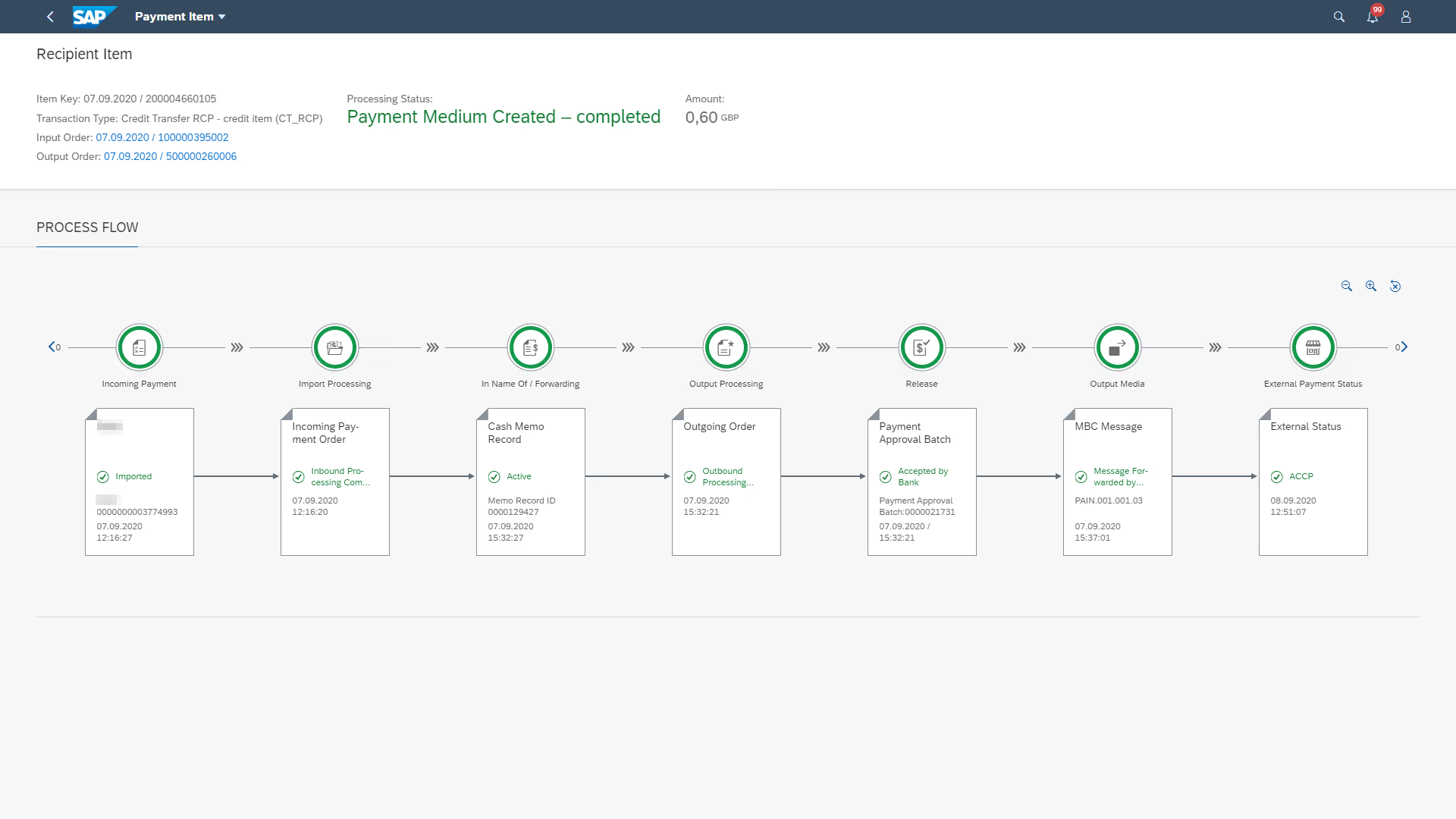
Payment error handling and investigations are now simplified in single apps compared to many SAP GUI transaction codes.
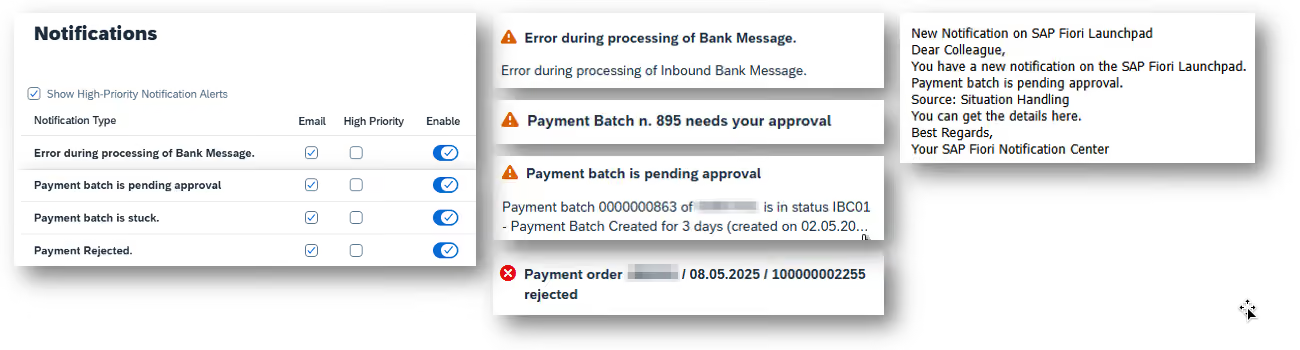
Many operational touchpoints can be shifted from daily manual control to an exception-based approach, using SAP’s standard situation-handling templates to automatically notify users in case of errors.
4. Reduction in system complexity and maintenance effort
Especially for more advanced payment scenarios like payment-on-behalf, APM’s rebuilt architecture dramatically simplifies configuration, reducing the number of touchpoints, tables and custom enhancements required. This lowers IT maintenance needs and shortens onboarding or change-request cycles.
The client appreciated the possibility of deprecating custom developments related to:
- Advanced value date control.
- Extension of payment order details.
- Extension of note to payee details for enhanced reconciliation.
- Manual upload from non-SAP entities.
Which due to the more advanced nature of APM could be handled within the standard configuration options.
5. Internal relationship management
Traditionally, treasury departments have relied on external relationship managers at banks to negotiate services, manage cut-off times, and optimize transaction costs. This external dependency often limited the ability to effectively enforce consistent policies across subsidiaries and regions.
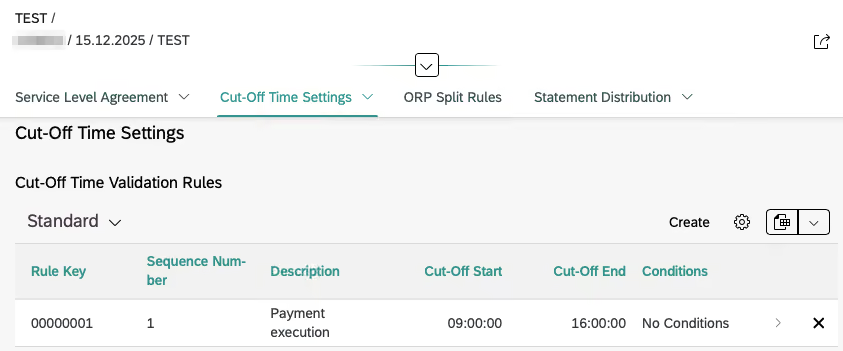
With APM, organizations can establish an internal relationship model between treasury and their subsidiaries. Instead of depending solely on external banks, treasury can now define and control key parameters internally, such as:
- Cut-off times for payment processing.
- Transaction cost structures and allocation rules.
- Access to specific payment products at subsidiary level.
This internal governance framework enables treasury to act as a strategic service provider within the group, ensuring compliance, cost efficiency, and operational consistency. By leveraging APM’s centralized capabilities, corporates can deliver banking-like services internally, strengthening collaboration and transparency across the organization.
6. Simplification of head office accounting
In the legacy IHC setup, payment processing relied on a series of technical accounts used to manage internal postings, clearing activities, and interim cash movements. While necessary for the old architecture, these technical accounts introduced significant complexity for head office accounting. Each account required configuration, reconciliation, and monitoring, and the associated GL transfer and statement integrations added additional layers of effort. As a result, even straightforward payment flows generated multiple postings and dependencies in the general ledger.
With the redesigned architecture of SAP In-House Banking, this complexity is largely eliminated. IHB no longer requires the same web of technical accounts, as internal movements are handled more directly within the internal bank structure. This reduction in system artefacts greatly simplifies the accounting model for the head office, resulting in fewer reconciliation points, cleaner GL posting flows, and a more transparent end-to-end process. The outcome is a more efficient, maintainable, and audit-friendly accounting environment that aligns better with modern treasury and finance operating models.
7. Enrichment and validations
APM introduces improved capabilities for managing needs of internal enrichment or validations during payment processing.
Certain payment scenarios required validation of recipient account details. APMs powerful Enrichment and Validation framework provides a long list of out of the box enrichment and validation function and the option to create customer specific validations prior to forwarding payments for execution.
Central recipient whitelisting or sanctions list screening is also natively supported within this framework.
8. Scalable foundation for future treasury innovation
Advanced Payment Management is the strategic platform SAP will invest in going forward. New S/4HANA innovations like API integration, Verification of Payee integration, embedded analytics, and support for real-time treasury processes are capabilities that will not be extended into legacy modules originating from ECC.
Keep in touch on social
Follow us on LinkedIn to keep up to date with all our news