
Asset-Liability Management (ALM)
Prefer reading offline?
Why Bank Treasuries Must Evolve from Control Function to Strategic Engine
For decades, Asset–Liability Management (ALM) has been a cornerstone of bank treasury control, focused on regulatory compliance, balance-sheet protection, and funding stability. Its primary mandate was clear: safeguard the balance sheet,satisfy regulatory requirements, and ensure funding stability.
That mandate remains essential – but it is no longer sufficient.
In today’s environment of sustained interest-rate volatility, faster-moving liquidity stress, and heightened supervisory scrutiny, ALM is being pulled into the strategic core of the bank. Treasury functions are expected not only to measure risk, but to actively shape the balance sheet and inform management decisions in near real time.
Balance-sheet risks now crystallise faster, behavioural assumptions are challenged more directly, and senior management expects insight that can support decisions as conditions change. As a result,the traditional role of ALM as a periodic control and reporting function is being stretched beyond its original design.
The New Reality for Bank Treasuries
Treasuries now operate under conditions that expose the limitations of traditional ALM approaches:
- Rapid shifts in interest-rate curves and basis risk
- Increased sensitivity of deposits to pricing and confidence
- Liquidity stress events that develop faster than legacy reporting cycles
- Greater regulatory focus on assumptions, governance, and explainability
- Pressure to link balance-sheet risk to profitability and capital allocation
As a result, treasury teams are increasingly asked questions that legacy ALM frameworks were never designed to answer:
- How resilient is our funding profile under severe but plausible stress?
- What is the real optionality embedded in our deposit base?
- How do pricing, FTP, and hedging decisions interact at the balance-sheet level?
- Which management actions matter most, and when?
Answering these questions requires more than enhanced reporting. It requires a fundamentally different operating model for ALM.
ALM as a Strategic Treasury Capability
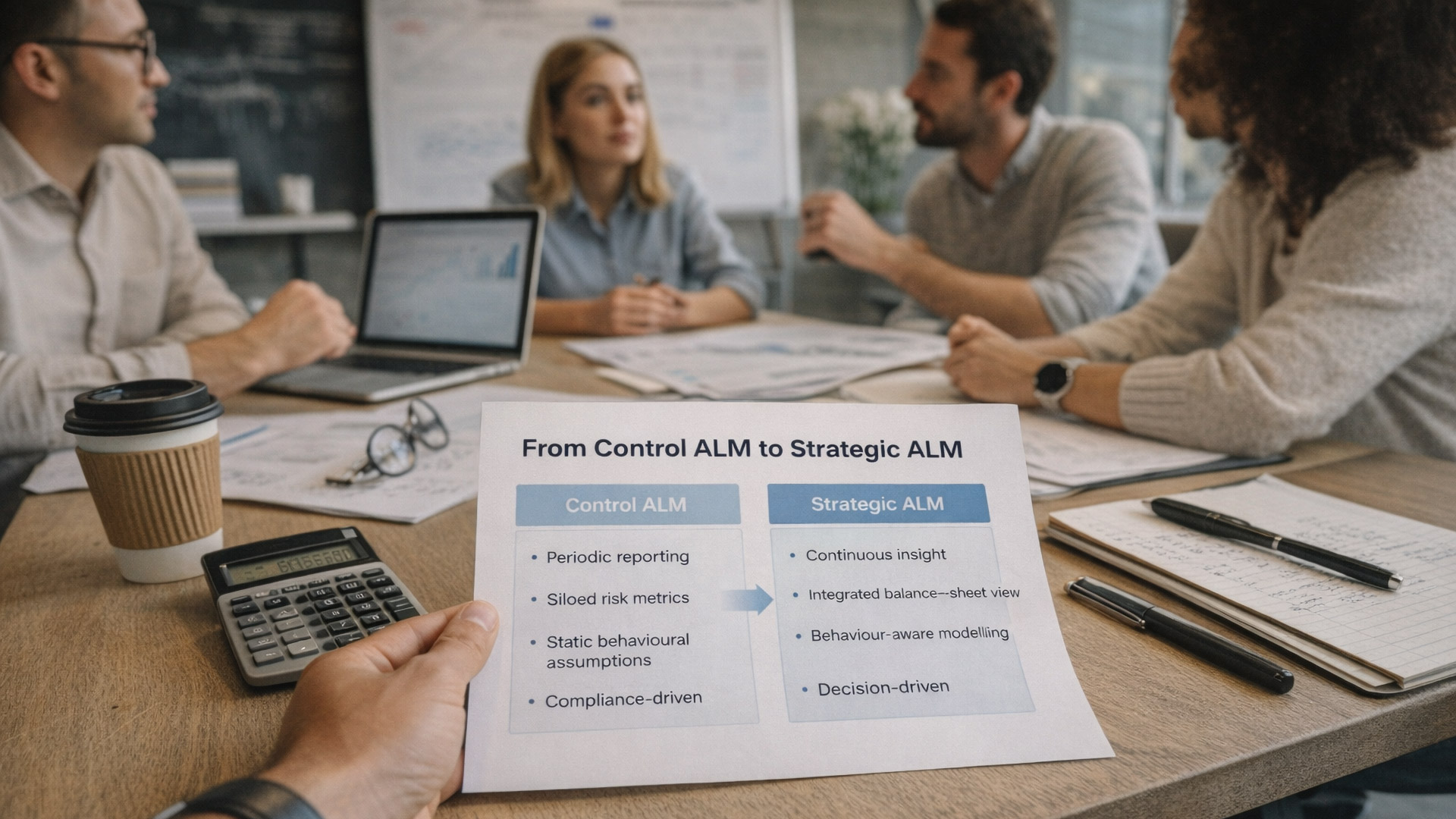
Leading treasuries are redefining ALM as an integrated decision-making framework, rather than a standalone risk measurement exercise.
This shift has three defining characteristics:
1. From Periodic to Continuous Insight
ALM is moving away from static monthly or quarterly cycles toward more frequent, event-driven analysis. Treasuries increasingly need the ability to to reassess exposures as market conditions change, update scenarios quickly and consistently, and support management decisions with timely, decision-relevant insight.
2. From Siloed Metrics to a Coherent Balance-Sheet View
Interest-rate risk, liquidity risk, FTP, capital, and profitability are deeply interconnected. Yet many organisations still analyse them in isolation.
A strategic ALM framework aligns these perspectives, enabling treasuries to understand trade-offs rather than optimise individual metrics, ensure consistency between risk appetite, pricing, and funding strategy, and communicate a single, coherent balance-sheet narrative to senior management.
3. From Assumption-Driven to Behaviour-Aware
Customer behaviour, particularly in deposits and loan prepayments, has become one of the most significant drivers of ALM outcomes.
Modern ALM therefore requires transparent and well-governed behavioural models, regular recalibration and back-testing, and clear accountability for assumptions and their impact. This is as much an organisational challenge as a technical one.
The Role of ALM Technology in Treasury Transformation
ALM technology is a critical enabler, but itdoes not create value on its own.
From a treasury perspective, effective ALM platforms must support how decisions are actually made, not just how risks are calculated. Key expectations include:
- Timeliness: the ability to run scenarios and sensitivities on demand
- Consistency: shared data, assumptions, and scenarios across risk, treasury, and finance
- Flexibility: support for evolving regulatory requirements and internal use cases
- Transparency: explainable outputs suitable for senior management and supervisors
- Governance: strong controls over data, models, and decision workflows
Importantly, value is realised only when ALM insights are embedded into core treasury decisions such as pricing, funding planning, hedging, and contingency actions - supported by clear decision rights and operating-model alignment.
Where Many Bank Treasury Transformations Stall
In practice, ALM initiatives often stall due to misalignment – not because of insufficient ambition. Common gaps emerge between treasury, risk, and finance on objectives and ownership; between business intent and technical implementation; and between regulatory compliance and the strategic use of ALM outputs.
Successful ALM transformations therefore require a clear treasury target operating model, well-defined governance around assumptions and decision rights, and a phased approach that delivers early insight while building long-term capability.
ALM transformations frequently cut across organisational boundaries, data architectures, risk frameworks, and regulatory expectations. Without a clear roadmap, even well-intentioned initiatives risk becoming technology-driven exercises rather than true balance-sheet improvements.
ALM as a Competitive Advantage
When executed well, ALM becomes more than a safeguard. It becomes a source of competitive advantage.
Treasuries with strong ALM capabilities are better positioned to to act decisively in periods of market stress, optimise balance-sheet structure without undermining resilience, support sustainable growth aligned with risk appetite, and engage credibly with regulators, boards, and investors.
In an environment where uncertainty is the norm, the ability to actively understand and shape the balance sheet is one of the most valuable capabilities a bank treasury can possess.
Trusted Partner for Bank Treasuries
SkySparc partners with bank treasury teams to help turn ALM from a control function into a strategic capability. We support treasury-led operating-model design, define robust governance frameworks, and deliver scalable ALM implementations with precision and supervisory confidence.
By embedding automation, scenario orchestration, and optimisation logic directly into ALM operating models, we enable treasuries to manage balance-sheet risk dynamically, efficiently, and with clarity.
Building ALM Capabilities That Endure
In an environment defined by volatility and uncertainty, ALM is no longer a static control function. It is a core capability that determines how effectively a bank can protect, optimise, and deploy its balance sheet.
The question facing bank treasuries today is no longer whether ALM must evolve, but how quickly – and how deliberately.
Those that treat ALM as a strategic capability, supported by the right operating model, governance, and technology will be better equipped to navigate volatility and shape their balance sheet with confidence.
Keep in touch on social
Follow us on LinkedIn to keep up to date with all our news